Return on Response
Saving time, money and lives through behavioral healthcare partnerships for public safety
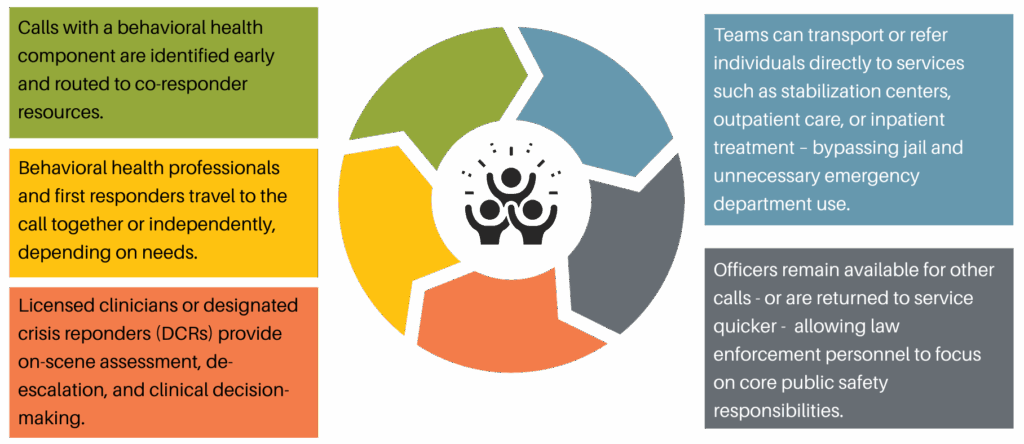
Behavioral health co-response models pair law enforcement and other first responders with licensed mental health professionals to respond to crises involving mental health and substance use-related needs. The model is grounded in providing the right response at the right time – deploying mental health professionals alongside first responders to de-escalate situations, conduct on-scene clinical assessments, and connect individuals to appropriate community-based services and supports.
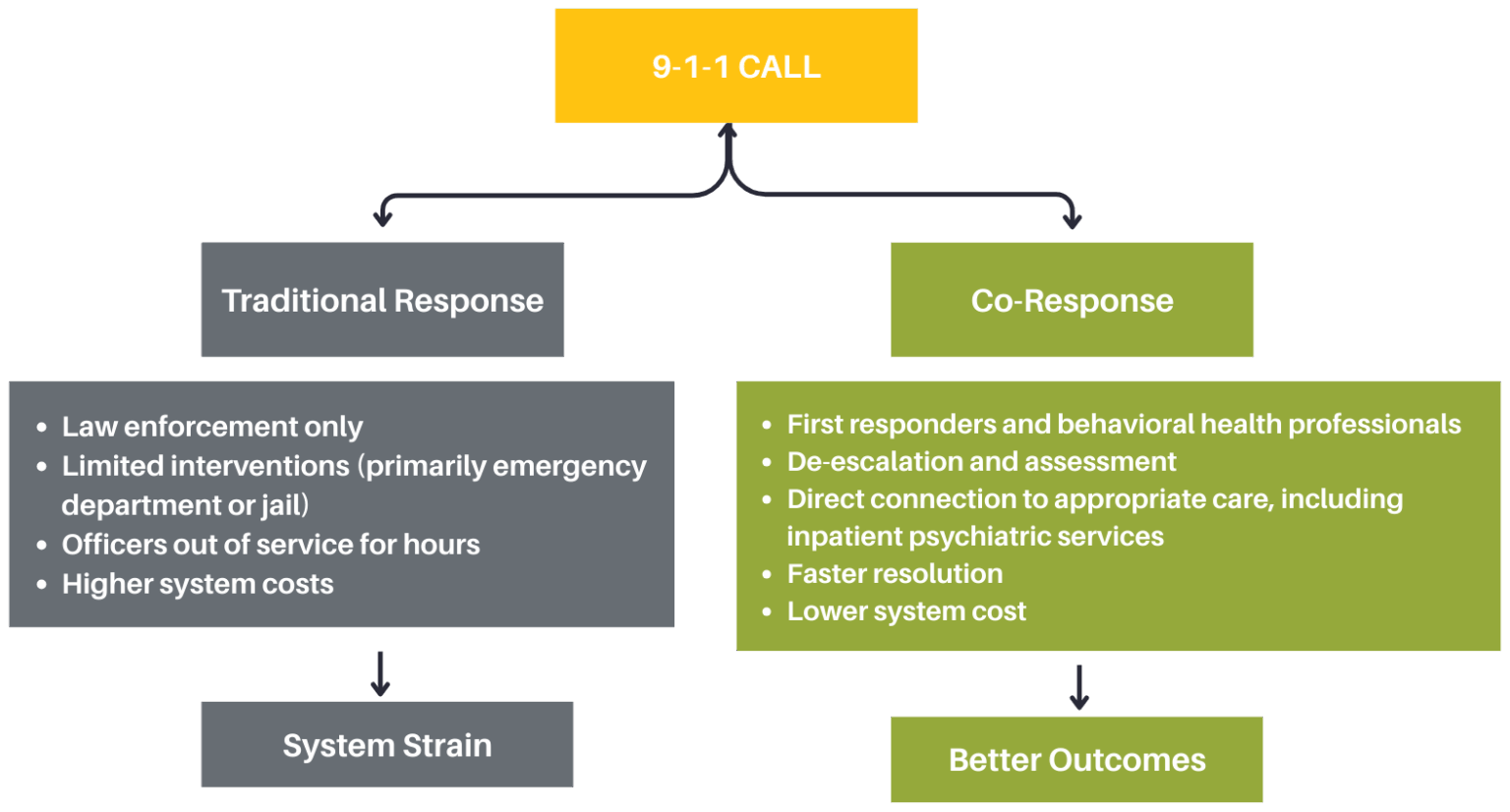
By addressing behavioral health needs at the point of crisis, co-response programs help individuals access care faster while reducing unnecessary arrests and emergency department visits. Just as importantly, this approach allows law enforcement and first responders to return to service more quickly – or remain in service – freeing up critical public safety resources.
Fourfront Contributor member organizations have been implementing and advancing co-response models for years. Across programs statewide, the results speak for themselves: improved safety for all involved, better outcomes than traditional diversion, and a stronger return on investment for communities that are committed to smarter, more effective crisis response.
A Closer Look at Co-Response Models
The Benefits of Co-Response
Fiscal Prudence
Co-response models deliver real system-wide savings. Incarceration, emergency department visits, and repeated crisis calls cost far more than timely behavioral health interventions and access to preventive care.
Improved Safety
Combining community behavioral health with law enforcement and other first responders strengthens a crucial part of the community safety net – or as we like to say, the community power net.
Better Outcomes
Having behavioral health professionals respond in moments of crisis means that individuals receive immediate clinical support that meets their needs in real time.
Co-Response in Action
Community behavioral health is largely funded through Medicaid and supported by state- and county-administered behavioral health resources. Protecting this funding is essential to supporting co-responder programs across Washington, which keep our communities safe
Return on Response in Yakima County
Fourfront Contributor member organization Comprehensive Healthcare has been leading the way with its Field Response Program in Central Washington, which pairs behavioral health professionals with law enforcement to address mental health crises and substance use needs across Yakima County.
Today, the Field Response Program is made up of 18 team members and includes Designated Crisis Responders (DCRs), case managers, and peer support specialists. The team operates two daily shifts, ensuring services are available from 8 a.m. to 11:30 p.m.
These teams are embedded directly within law enforcement agencies – some based at the Yakima County Sheriff’s Office and others co-located at the Sunnyside Police Department, and they respond to calls across Yakima County. Having behavioral health professionals based out of the law enforcement agencies helps build trust, improve coordination, and allow for a faster, more effective response.
Speaking of response, over the past year, the team achieved an average response time of just 24 minutes – a life-saving difference when minutes matter during a crisis. During that same period, the program saw a 319 percent increase in crisis services delivered, representing hundreds more community members receiving timely behavioral health support instead of entering the emergency healthcare or criminal justice systems.
The impact of this model is evident not only in program data but also in how it has changed day-to-day operations for both law enforcement and mental health professionals.
“Helping someone in crisis can take officers out of service for hours. Having the Field Response team provides a better and more appropriate resource, and gets officers back into service more quickly. For so long, we didn’t have any alternatives. Now, we’re starting to see these systems built – and they’re making a real difference.”
Yakima County Sheriff Robert Udell
Hear more from Sheriff Udell:
Read more about Comprehensive Healthcare’s Field Response Program here.
Return on Response in Spokane County
Over the past six years, Frontier Behavioral Health has transformed its partnerships with first responder agencies, integrating behavioral health professionals into emergency response and serving more community members than ever before.
Frontier currently operates three co-responder teams with the Spokane Police Department and three with the Spokane County Sheriff’s Office. Within each team, behavioral health professionals ride along with law enforcement officers throughout the day and, together, respond to 9-1-1 calls that include a mental health component.
Separately, the Behavioral Response Unit (BRU), a co-response partnership between Frontier and the Spokane Fire Department, consists of two paramedics and two behavioral health clinicians. The BHU gets dispatched – or can self-assign – to calls that could benefit from mental health support.
The BRU was the first firehouse-based diversion team established in Washington state. Designed to reduce unnecessary hospital transports, the team distinguishes between psychiatric emergencies that require medical attention and non-emergent behavioral health crises that can be managed on-scene, followed by community-based outpatient treatment programs or short-term inpatient care.
Across all these partnerships, the co-responder teams are focused on de-escalation, assessment, safety planning, and connection to services, including crisis stabilization and detox.
“Co-response is about dignity and stabilization in the least restrictive way possible. When behavioral health professionals and first responders work together, people get help faster, and outcomes improve for everyone involved.”
Rayanne Paget, Program Administrator for Frontier’s Co-responder and Mobile Rapid Response Teams
Read more about Frontier’s co-responder teams here.
Return on Response in Whatcom County
Compass Health, Northwest Washington’s behavioral healthcare leader, partners with the Bellingham Fire Department to improve crisis care coordination in Whatcom County. Through the partnership, Compass Health embedded a Community Outreach Designated Crisis Responder (DCR) in the fire department’s downtown station – alongside community paramedics and staff from other local resource organizations.
With direct access to the dispatch system, Compass Health’s DCR can respond immediately to 911 calls involving a behavioral health component. Once on the scene, they lead de-escalation efforts, conduct assessments, and connect individuals to appropriate services.
“Our partnership with Compass Health grew out of what we were seeing on the ground here every day. By bringing emergency medicine and behavioral health together, we’re able to look at each situation more completely and respond in ways that truly support people in crisis.”
Scott Ryckman, Bellingham Fire Department division chief of emergency medical services
Read more about Compass Health’s co-responder program here.